

Free Printable Easy Logic Puzzles for Kids
Free Printable Easy Logic Puzzles for Kids
Logic puzzles are a fun way for children to practice critical thinking, concentration, and problem-solving skills. These free printable logic puzzle worksheets help kids learn how to compare clues, think carefully, and find the correct answers step by step.
Our easy logic puzzles are perfect for elementary school students, homeschool activities, early finishers, classroom centers, and quiet learning time at home. Children can improve their reading comprehension, logical reasoning, attention to detail, and deductive thinking skills while having fun solving each puzzle.
Why Are Easy Logic Puzzles Great for Early Readers and Beginners?
📖 Story-Based & Picture-Based Learning
Instead of filling in a logic grid, children solve these puzzles by matching pictures, characters, objects, or simple facts based on a short story and a few clues. They learn to use the process of elimination while working directly with visual information, making the puzzles accessible and engaging for young learners.
🚀 The Perfect Introduction to Logic Puzzles
Easy logic puzzles provide an ideal first step before children begin solving traditional logic grid puzzles. They help young learners develop the essential skills needed for more advanced deduction activities, including careful reading, comparing clues, organizing information, and eliminating incorrect answers.
Because they do not require a grid or matrix, these puzzles are especially suitable for younger children, early readers, and beginners who are just starting to explore logical thinking activities.
This collection includes printable PDF worksheets with animals, school subjects, holidays, neighbors, pets, sports, vehicles, and many other child-friendly themes. All puzzles are designed especially for younger children and beginners.
⭐ 32 Free Printable Logic Puzzle Worksheets
Download and print these free logic puzzles for hours of educational fun!
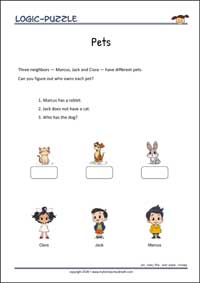
🐾 Pets
Three neighbors — Marcus, Jack and Clara — have different pets.
Can you figure out who owns each pet?
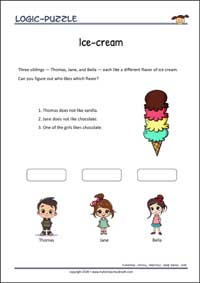
🍦 Ice Cream
Three siblings — Thomas, Jane, and Bella — each like a different flavor of ice cream.
Can you figure out who likes which flavor?
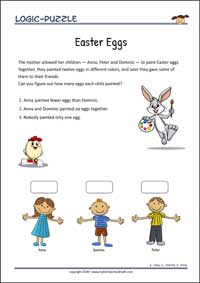
🥚 Easter Eggs
The mother allowed her children — Anna, Peter and Dominic — to paint Easter eggs.
Can you figure out how many eggs each child painted?
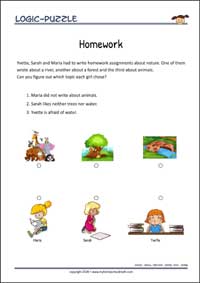
📚 Homework
Yvette, Sarah and Maria had to write homework assignments about nature.
Can you figure out which topic each girl chose?
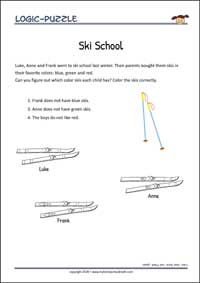
🎿 Ski School
Luke, Anne and Frank went to ski school last winter.
Can you figure out which color skis each child has?
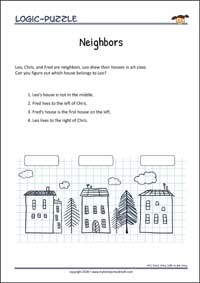
🏡 Neighbors
Leo, Chris, and Fred are neighbors. Leo drew their houses in art class.
Can you figure out which house belongs to Leo?
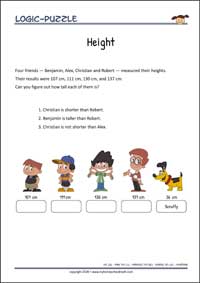
📏 Height
Four friends — Benjamin, Alex, Christian and Robert — measured their heights.
Can you figure out how tall each of them is?
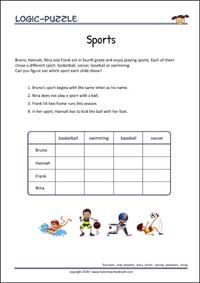
⚽ Sports
Bruno, Hannah, Nina and Frank are in fourth grade and enjoy playing sports.
Can you figure out which sport each child chose?
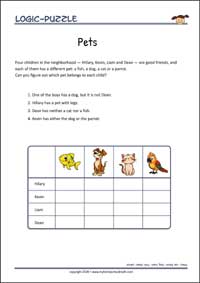
🐾 Pets
Four children in the neighborhood are good friends, and each of them has a different pet.
Can you figure out which pet belongs to each child?
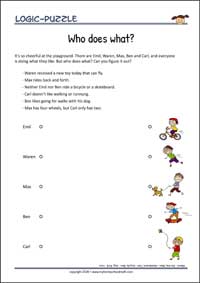
🧩 Who does what?
It’s so cheerful at the playground. There are Emil, Waren, Max, Ben and Carl, and everyone
is doing what they like. But who does what?
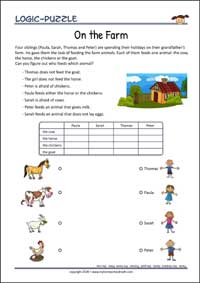
🏡 On the Farm
Four siblings are spending their holidays on their grandfather’s farm.
Can you figure out who feeds which animal?
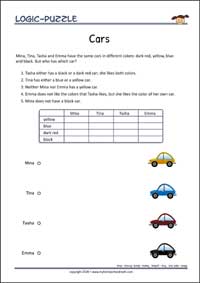
🚗 Cars
Mina, Tina, Tasha and Emma have the same cars in different colors.
But who has which car?
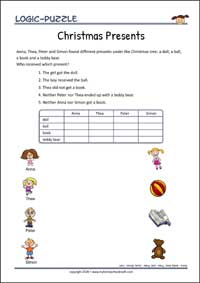
📍 Christmas Presents
Anna, Thea, Peter and Simon found different presents under the Christmas tree.
Who received which present?
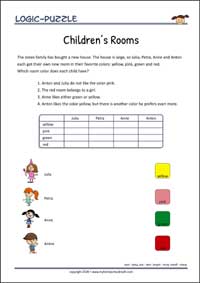
🛏️ Children’s Rooms
The Jones family bought a new house. The four siblings each got their own room in their favorite color.
What color is each room?
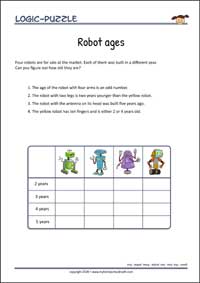
🤖 Robot Ages
Four robots are for sale at the market. Each of them was built in a different year.
Can you figure out how old they are?
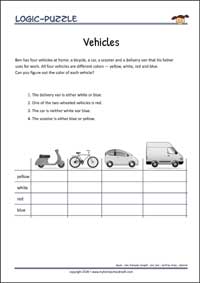
🚗 Vehicles
Ben has four vehicles at home: a bicycle, a car, a scooter and a delivery van.
Can you figure out the color of each vehicle?
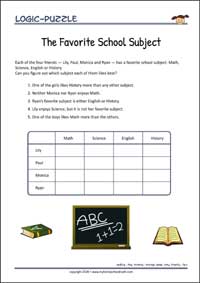
📚 School Subjects
Each of the four friends — Lily, Paul, Monica and Ryan — has a favorite school subject.
Can you figure out which subject each of them likes best?
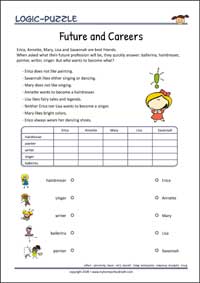
🚶 Future and Careers
Erica, Annette, Mary, Lisa, and Savannah want to be a ballerina, a hairdresser, a painter, a writer, or a singer when they grow up. But who wants to be what?
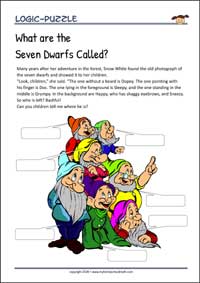
⛏️ Seven Dwarfs
Many years after her adventure in the forest, Snow White found the old photograph of the seven dwarfs and showed it to her children. Can you tell where Bashful is?
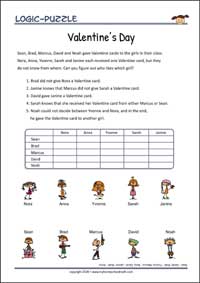
💌 Valentine’s Day
Sean, Brad, Marcus, David and Noah gave Valentine cards to the girls in their class.
Can you figure out who likes which girl?
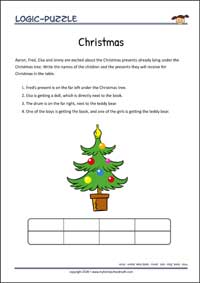
🎄 Christmas
Four siblings are already very excited about the Christmas presents that are under the Christmas tree. Write down the children's names and the presents they will receive.
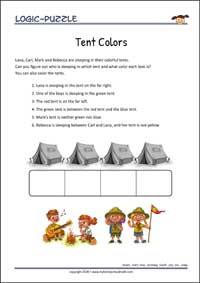
⛺ Tent Colors
Lana, Carl, Mark and Rebecca are sleeping in their colorful tents.
Can you figure out what color each tent is?
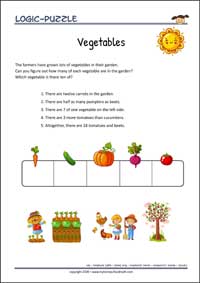
🥕 Vegetables
The farmers have grown lots of vegetables in their garden.
Can you figure out how many of each vegetable are in the garden?
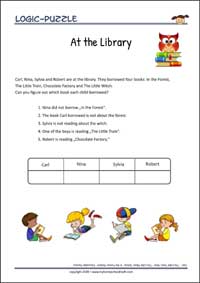
📚 At the Library
Carl, Nina, Sylvia and Robert are at the library. They borrowed four books.
Can you figure out which book each child borrowed?
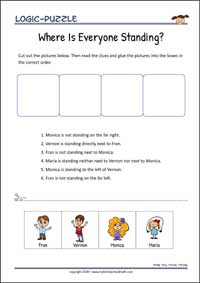
👧 Where Is Everyone Standing?
Cut out the children's pictures. Then read the clues and glue the pictures into the boxes in
the correct order.
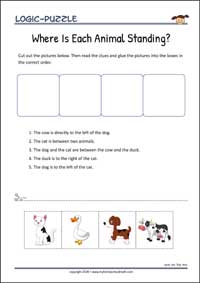
🐾 Where Is Each Animal Standing?
Cut out the animal pictures. Then read the clues and glue the pictures into the boxes in
the correct order.
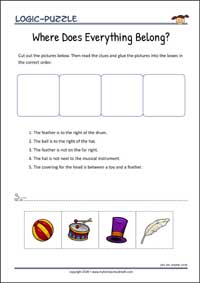
🎩 Where Does Everything Belong?
Cut out the pictures of the items. Then read the clues and glue the pictures into the boxes in
the correct order.
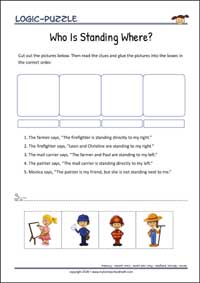
👥 Who Is Standing Where?
Cut out the pictures of the people. Then read the clues and glue the pictures into the boxes in
the correct order.
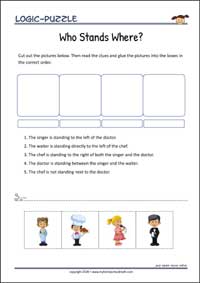
👫 Who Stands Where?
Cut out pictures of people at the bottom of the paper. Then read the clues and glue the pictures into the boxes in
the correct order.
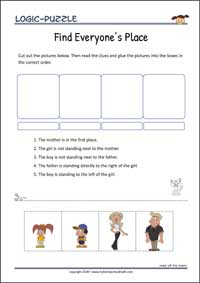
👨👩👧👦 Find Everyone’s Place
Cut out pictures of the family members. Then read the clues and glue the pictures into the boxes in
the correct order.
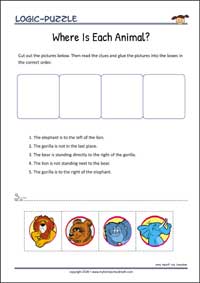
🦁 Where Is Each Animal?
Cut out pictures of the four animals. Then read the clues and glue the pictures into the boxes in
the correct order.
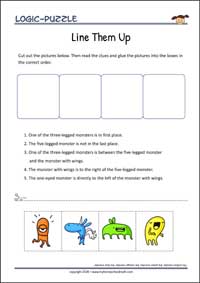
👾 Line Up The Monsters
Cut out pictures of the four monsters. Then read the clues and glue the pictures into the boxes in
the correct order.
✅ Logical Thinking • ✅ Early Reading Skills • ✅ Critical Thinking & Problem-Solving • ✅ Concentration Practice • ✅ Fun Learning Through Play
🧩 Ready for a bigger challenge?
Try our Medium Logic Puzzles →
Try our Medium Logic Puzzles →
More Puzzle Activities for Kids
If your child enjoys logic puzzles, explore our collection of additional brain games, printable crossword puzzles and educational activities for children. These fun learning resources support concentration, memory, visual perception, reasoning, and problem-solving skills while encouraging curiosity and independent thinking.
Frequently Asked Questions
What are logic puzzles for kids?
Logic puzzles are educational brain games that help children use clues and reasoning to solve problems. Children practice reading comprehension, logical reasoning, comparing information and finding the correct answers step by step.
What age group are these logic puzzles for?
These easy printable logic puzzles are designed mainly for children ages 6–10, including elementary school students and beginners who are learning logical thinking and practicing reading comprehension.
What skills do logic puzzles help children develop?
Logic puzzles can improve critical thinking, concentration, reading comprehension, problem-solving, attention to detail and deductive reasoning skills. Finding the correct solution also boosts a child’s self-confidence and gives them a sense of accomplishment.
Are these logic puzzle worksheets free?
Yes! All logic puzzle worksheets on this page are free to download and print for personal, classroom and homeschool use.
Can teachers use these printable worksheets in the classroom?
Absolutely! These worksheets are great for classrooms, homeschooling, morning work, early finisher activities, learning centers and quiet educational time.
Do children need special materials to solve the puzzles?
No special materials are needed. Most worksheets only require a pencil, and some children may also enjoy using colored pencils to highlight clues. A few worksheets require scissors and glue, but they can also be solved using only a pencil.
Are the puzzles suitable for beginners?
Yes. The puzzles in this easy collection are specially designed for young learners and beginners who are just starting with logic and deduction activities.
