

1st Grade Math Worksheets and Online Practice




1st Grade Math Worksheets and Online Practice
These free first-grade math worksheets and online activities help children build confidence with numbers and develop important mathematical skills. Children can practise counting, comparing numbers, addition and subtraction, recognizing shapes, and telling time.
The collection includes printable PDF worksheets and dynamically generated exercises. The generated worksheets allow children to practise the same skills with different numbers, providing additional practice whenever they need it. Many activities also include answer keys, making it easier for parents and teachers to check completed work.
Choose a topic below to find activities that match your child's learning goals, whether you are practising together at home or using the worksheets in the classroom.
Fun Mental Math Card and Dice Game
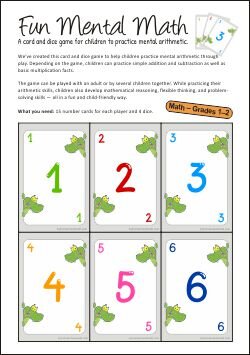
Not all math practice needs a worksheet. This card and dice game gives children an opportunity to practise mental arithmetic through play. Depending on the game, players work with addition and subtraction and, in some versions, basic multiplication facts.
Children can play with an adult or with other children. Taking turns, working out calculations and deciding how to use the numbers encourages flexible thinking, mathematical reasoning and problem-solving skills.
What you need: 15 number cards per player and 4 dice.
Math activities for Grades 1–2
Children build a strong foundation in mathematics by learning to recognize numbers, count objects, and understand how numbers relate to one another. These worksheets provide practice with counting, ordering and comparing numbers, recognizing number patterns, and exploring place value. Some generated activities also extend beyond 20, allowing children to practise with larger numbers as their confidence grows.
Addition and subtraction worksheets help children understand how quantities combine and how numbers change when quantities are added or taken away. Children can practise basic calculations, find sums and differences, solve missing-number problems, and explore number patterns. Activities involving tens and ones also introduce useful strategies for mental arithmetic.
Practising addition and subtraction together helps children recognize which operation is needed for each calculation. These worksheets combine different types of problems and encourage children to think carefully about numbers and the relationships between them. They also include equation comparisons and rounding exercises.
Geometry activities help children recognize and describe shapes, explore three-dimensional objects, and become familiar with lines and symmetry. Visual exercises encourage careful observation and help children identify similarities, differences, and patterns in the shapes around them.
Measurement connects mathematics with everyday life. These worksheets introduce children to units of time and comparisons of length and weight. They help children practise reading, comparing, and working with measurements, providing a starting point for understanding how mathematical concepts are used in familiar situations.

